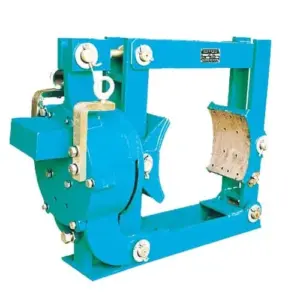

Electro-hydraulic thrusters (like Ed, YT1, ZEd series) are designed to work upright. But in tight spaces—under a conveyor belt, inside a wind turbine nacelle, or on a compact winch frame—engineers often ask: “Can I mount this thruster horizontally?”
The short answer is: Maybe, but be careful. Standard thrusters will fail if laid flat without modification. The oil level drops below the pump intake, air gets sucked in, and you lose braking force (or burn out the motor). This article explains the rules for mounting orientation, the risks of tilting, and the special modifications required for horizontal use on our YWZ13 drum brakes and SH disc brakes.
[Image Placeholder] Diagram showing: (A) Vertical thruster (oil level covers pump), (B) Horizontal thruster (oil level exposes pump intake – air cavitation).
1) The Standard Vertical Mount (0° to ±15°)
Most thrusters are built with the motor on the bottom and the oil tank/cylinder on top. The pump is submerged at the bottom of the oil reservoir.
- Safe Angle: Typically up to ±15° tilt from vertical is allowed without issues.
- Why: Within this range, the oil level stays high enough to cover the pump suction port even when the rod extends (which lowers the tank level slightly).
2) The Risk of Horizontal Mounting (90°)
If you lay a standard vertical thruster on its side:
- Air Pocket Shifts: The air gap (expansion space) moves to the side wall.
- Pump Starvation: The pump intake is now halfway up the side. As soon as the rod extends, the oil level drops, exposing the intake to air.
- Result: Cavitation (noise), jerky movement, loss of force, and foaming oil. The brake may not release fully or may drift closed.
- Seal Leakage: The rod seal is now constantly submerged in oil (instead of just splash). If the seal isn’t perfect, it leaks faster.
3) How to Mount Horizontally Safely
You can order thrusters for horizontal use, but they are not the same part number as vertical ones. They have internal modifications:
Modification A: Suction Tube Extension
The manufacturer adds a curved suction tube inside the tank that reaches down to the lowest point of the horizontal housing (the “belly”). This ensures the pump always draws oil, not air.
Modification B: Return Port Location
The oil return path must be below the oil level to prevent aeration (foaming). A horizontal thruster often has a different internal baffle or return tube.
Modification C: Breather/Filler Cap Position
The breather must be at the highest point to vent air. On a horizontal unit, the standard top cap is now on the side (bad). The housing is often rotated 90° relative to the foot, or a special elbow fitting is installed to keep the breather vertical.
[Internal Link] YWZ13 Series (Specify mounting orientation when ordering)
4) “Inverted” Mounting (Motor on Top) – Don’t Do It!
Mounting a thruster upside down (rod pointing down) is almost never allowed for standard industrial units.
- Air Trap: Air bubbles rise to the pump intake (now at the top). The pump sucks air immediately.
- Sludge: Dirt and water settle on the rod seal (now at the bottom), destroying it quickly.
- Motor Bearing: The thrust bearing is often not designed for the rotor weight hanging in reverse.
5) Checking Oil Level in Non-Vertical Mounts
The standard sight glass or dipstick is useless if the thruster is tilted. You must use the fill plug method:
- Level the Unit: If possible, temporarily level the thruster for checking.
- Know the Volume: If you can’t level it, drain the oil completely and refill with the exact volume specified in the manual for horizontal use. (Horizontal units often require slightly more oil to keep the pump submerged).
- Check for Leaks: Horizontal mounting puts more pressure on the housing gasket. Watch for weeping oil.
6) Ordering the Right Thruster
When ordering a replacement thruster or a new brake, never assume vertical is the only option. If your design requires horizontal mounting:
- Specify “Horizontal Mounting” (H-mount): We will install the suction tube kit and rotate the terminal box/breather.
- Specify “Rod Up” or “Rod Down” (for angled mounts): If it’s 45°, tell us. We can adjust the internal pickup.
Need a horizontal thruster or brake?
We supply custom-configured thrusters (Ed, YT1, ZEd) for horizontal, inclined, and side-mount applications. Don’t risk cavitation—get the unit built for your specific installation angle.
[Internal Link Placeholder] Contact us for horizontal thruster specifications and pricing.