
In many industrial drum brake systems, the brake wheel (sometimes called a brake drum in certain contexts) is treated as “just a rotating part.” In reality, it is the friction partner that largely determines wear rate, temperature behavior, noise/vibration, and even how consistent your brake torque feels over time.
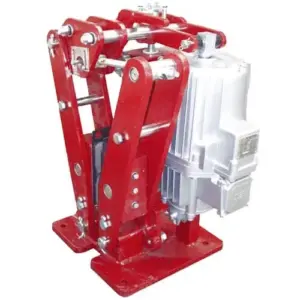
This is especially true for electro-hydraulic drum (block) brakes widely used in cranes, conveyors, and heavy machinery—such as our YWZ13 series electro-hydraulic drum brakes. If the brake wheel material or heat treatment is mismatched to the duty cycle and friction lining, you’ll typically see one (or more) of these field outcomes: rapid lining wear, brake wheel scoring, blueing/hot spots, torque instability, or cracking.
Below is a practical engineering view of brake wheel materials and heat treatment options, with data ranges you can use in specifications and acceptance checks.
[Image Placeholder] Close-up of a brake wheel friction track showing (A) healthy wear pattern, (B) scoring, (C) thermal blueing.
1) What the brake wheel really does (beyond “providing a surface”)
For drum/block brakes, braking torque is created by the friction lining pressing onto the rotating brake wheel. The wheel must do four jobs at once:
- Provide a stable friction surface so torque is repeatable from stop to stop.
- Absorb and spread heat generated during braking (thermal mass + conductivity).
- Resist wear and scoring from the lining under load and contamination (dust, moisture, scale).
- Survive thermal cycling without cracking, distortion, or severe runout growth.
That’s why “harder is better” is not a safe rule. A wheel that is too hard may resist wear, but becomes more vulnerable to thermal cracking and may accelerate lining wear. A wheel that is too soft may protect the lining, but can groove quickly and lose effective friction geometry.
2) Common brake wheel materials (and what the numbers mean)
Industrial brake wheels are typically made from gray cast iron, ductile iron, or cast steel. The best choice depends on duty cycle, shock loading, and temperature profile.
| Material family (typical grades) | Typical tensile strength | Typical ductility | Typical hardness range (HB) | Practical notes for braking |
|---|---|---|---|---|
| Gray cast iron (e.g., HT250/HT300) | ~250–300 MPa | Low (brittle) | ~180–240 HB | Good damping (less chatter), stable friction; lower toughness—watch for thermal cracking in harsh duty |
| Ductile iron (e.g., QT500-7) | ~500 MPa | ~7% elongation | ~170–240 HB (varies by treatment) | Better toughness than gray iron; good compromise for outdoor and shock-prone machinery |
| Cast steel (e.g., ZG35 / ZG45) | ~500–700 MPa (grade dependent) | Higher than cast iron | ~170–260 HB (as treated) | High toughness and overload tolerance; may need careful friction pairing to avoid lining wear and noise |
Note: the ranges above are typical industry values. Your actual acceptance criteria should follow your design drawing and the brake duty profile.
Quick interpretation
- Gray cast iron: widely used because it “behaves well” in friction—good damping and stable surface behavior, but lower toughness.
- Ductile iron: often chosen when impact/shock and outdoor service push gray iron toward cracking risk.
- Cast steel: chosen when toughness is the priority (heavy shock / risk of overload), but requires careful control of surface finish and lining selection.
[Image Placeholder] Microstructure comparison: gray iron flakes vs ductile iron nodules (illustrative).
3) Why hardness matters—plus the “hardness is not enough” reality
Hardness influences wear resistance, but wear is also affected by lining type, pressure distribution, contamination, and temperature. A classic wear relationship (used as a directionally useful model) is:
V \propto \frac{W \cdot s}{H}Where V is wear volume, W is normal load, s is sliding distance, and H is hardness. This explains why harder materials tend to wear more slowly. However, real brake wear often deviates because:
- High temperature can change friction film behavior and microstructure at the surface.
- Contamination (oil/dust) can turn wear into abrasion/scoring.
- Uneven contact (misalignment/runout) creates local hot spots and “selective wear.”
So we treat hardness as a controlled range, not a single “higher is better” target.
4) Heat treatment options for brake wheels (and what each one trades off)
Heat treatment is how you tune the balance between surface wear resistance and core toughness. Common approaches include:
A) As-cast / stress relief
Used when the base casting properties already meet requirements and the goal is mainly to reduce residual stress (improving dimensional stability). This can help reduce distortion and runout changes during early service.
B) Normalizing (common for cast steel wheels)
Normalizing refines grain structure and improves uniformity. It’s often chosen when you need consistent mechanical properties across the wheel, especially for thicker sections that otherwise cool unevenly.
C) Quench & temper (Q&T) (for higher strength/toughness targets)
Q&T improves strength and toughness but can raise hardness beyond what some lining systems like. If Q&T is used, specify a controlled hardness band and confirm friction pairing with your lining material (organic vs semi-metallic vs sintered).
D) Surface hardening (e.g., induction hardening) (only when justified)
Surface hardening creates a hard wear layer while keeping a tougher core. This can be useful in severe abrasive environments, but it increases the risk of surface thermal checking if the duty cycle produces high peak temperatures. If you specify surface hardening, you must also specify effective case depth and how hardness is measured (HB/HRC), plus how cracks are screened.
[Image Placeholder] Hardness test on brake wheel track (HBW) + example of measurement locations around circumference.
5) Practical selection: matching wheel material & treatment to duty cycle
If you’re selecting a brake wheel for a crane travel brake, a hoist, or a conveyor drive, start with the duty profile and failure mode you want to avoid.
If your main problem is rapid wheel wear / deep grooves
- Check for contamination (oil/grease) and abrasive dust first—material upgrades won’t fix a leaking gearbox seal.
- Confirm alignment and contact pattern. Uneven contact can “cut” grooves fast.
- Then consider moving from a softer wheel specification to a controlled higher hardness range, or moving from gray iron to ductile iron depending on your cracking history.
If your main problem is cracking / thermal checking
- Cracking is often a combination of high peak temperature + thermal cycling + residual stress.
- Review braking energy and temperature rise first (many cracks are duty-cycle issues).
- Consider higher toughness material options (ductile iron or cast steel) and stress-relief/normalizing to improve stability.
- Avoid pushing surface hardness unnecessarily high without proving thermal behavior.
If your main problem is unstable braking (chatter/noise/torque drift)
- Surface finish and material damping matter. Gray cast iron often performs well for vibration damping.
- Check runout, mounting alignment, and lining grade compatibility (friction coefficient stability).
- Confirm the brake releases fully—dragging can “polish” the wheel and change friction behavior.
Field reality: In many crane and conveyor applications, the most cost-effective improvement is not “harder steel,” but tighter control of clearance, release stroke, and oil contamination prevention.
6) What to specify when ordering a brake wheel (avoid vague requirements)
For procurement and engineering, the fastest way to get consistent brake wheels is to specify measurable requirements. A practical purchase spec should include:
- Material grade (e.g., HT/QT/ZG grade or equivalent)
- Heat treatment condition (as-cast / stress-relieved / normalized / Q&T / surface hardened)
- Hardness range on friction track (HB, measurement method HBW preferred for castings)
- Runout / concentricity limit at the friction track (tie this to your brake design)
- Surface finish requirement (Ra range) and “no deep casting defects” rule on track
- Inspection method: hardness points & count, visual criteria, optional MT/PT for crack screening (if critical duty)
[Internal Link Placeholder] Download: Brake Wheel Ordering Checklist (dimensions + material + hardness + inspection points).
7) Product note: matching brake wheels to brake families (why “OEM matching” reduces downtime)
In drum brake systems, the wheel and the lining are a matched friction pair. When customers retrofit a different wheel material or hardness without considering the lining, two things often happen:
- The lining wears unusually fast (wheel too hard / surface too aggressive).
- The wheel grooves or overheats (wheel too soft or poor surface condition).
For customers using our electro-hydraulic drum brake families (such as YWZ/YWZ13), we supply brake wheels as matched components (for example, our ZDL series brake wheels) so the friction behavior aligns with the brake’s intended torque and thermal profile.
[Internal Link Placeholder] ZDL Series Brake Wheel (product page)
[Internal Link Placeholder] Spare Parts: brake wheel + linings + pins/bushings kits for YWZ/YWZ13 brakes
8) Quick on-site checks for brake wheel health (what technicians can measure fast)
- Visual track condition: look for grooves, heat spots (blueing), glazing, and cracks.
- Runout check: a dial indicator on the track can identify distortion that causes uneven braking and pad wear.
- Temperature scanning: after a normal duty run, IR-scan the track—localized hot spots often indicate misalignment or dragging.
- Contamination check: oil/grease on the track is a root cause; fix leaks before replacing parts.
[Image Placeholder] Dial indicator runout check setup on brake wheel friction track.
Need help selecting the right brake wheel specification?
If you share your brake model (e.g., YWZ13 size), brake wheel dimensions, duty cycle (stops/hour + speed), environment (dust/oil/outdoor), and the friction lining type, we can recommend a brake wheel material and heat treatment target that balances wear life and cracking risk.
[Internal Link Placeholder] Contact our engineering team for brake wheel selection and replacement compatibility support.