
In the world of heavy lifting, gravity is the constant enemy. Whether you are operating a massive Ship-to-Shore (STS) crane at a busy port or an Overhead (EOT) crane in a steel mill, the ability to lift a load is only half the battle. The ability to stop and hold that load safely is where industrial crane brakes come into play.
As the most critical safety component in any hoisting system, the brake is the last line of defense against catastrophic failure. In this guide, we will explore the different types of crane brakes, how they work, and the key factors you must consider when selecting the right braking system for your machinery.
Why “Fail-Safe” is Non-Negotiable
Before diving into specific types, it is crucial to understand the concept of Fail-Safe Braking.
In industrial applications, almost all crane brakes are “Spring-Applied, Power-Released.” This means that in the event of a power failure, an emergency stop, or a system fault, the brake automatically engages using the mechanical force of powerful springs. This design ensures that the load is immediately secured, preventing it from falling.
At HMIC, safety is our priority. All our core product lines, including the YWZ Series Drum Brakes and YPZ2 Series Disc Brakes, feature this essential fail-safe design.
Types of Industrial Crane Brakes
Selecting the right brake depends heavily on the crane’s design and duty cycle. Here are the three most common categories:
1. Electro-Hydraulic Drum Brakes (The Industry Standard)
Drum brakes are the workhorses of the crane industry. They consist of two brake shoes that clamp onto a rotating drum.
- How they work: They are typically actuated by an electro-hydraulic thruster (like our Ed Series). When the thruster is powered, it pushes the shoes apart, releasing the drum. When power is cut, the spring clamps the shoes back onto the drum.
- Best for: General overhead cranes, gantry cranes, and conveyors where smooth deceleration and high reliability are required.
- Our Recommendation: The YWZ4 and YWZ9 Series are versatile, easy to maintain, and cost-effective.
2. Industrial Disc Brakes (High Performance)
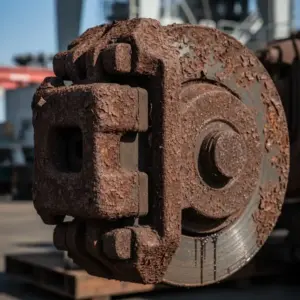
As cranes get larger and speeds get faster, disc brakes are becoming increasingly popular. They offer better heat dissipation and higher braking torque compared to drum brakes.
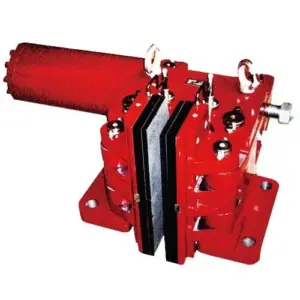
- Types: We offer both Caliper Disc Brakes (like the QP/CQP Series) for holding duties and Electro-Hydraulic Disc Brakes (like the YPZ2 Series) for high-duty service braking.
- Best for: High-speed container cranes, heavy-duty metallurgical cranes, and environments where compact design and high torque are essential.
3. Storm Brakes (Wind Protection)
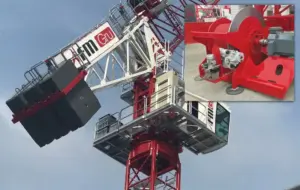
For outdoor cranes, such as Rail-Mounted Gantry (RMG) cranes and Ship Loaders, wind is a major threat.
- The Solution: Storm brakes (or windproof brakes) anchor the crane to the rails to prevent it from being blown away by typhoons or sudden gusts.
- Our Recommendation: Our YFX Series Iron Wedge Brakes and YJGQ Hydraulic Rail Clamps provide the static holding power needed to weather the storm.
5 Key Factors for Selecting the Right Crane Brake
When specifying a brake for your crane, consider these five critical parameters:
- Required Braking Torque: Always calculate the torque required to stop the full load, and apply a safety factor (typically 1.5 to 2.0 depending on safety standards like FEM or DIN).
- Actuation Method: Do you have a hydraulic power unit available, or do you need a self-contained electro-hydraulic thruster?
- Environment:
- Corrosive/Marine: Requires special paint and stainless steel pins (common in ports).
- Explosive: Requires Explosion-Proof Thrusters (like our Bed Series) for mining or oil & gas applications.
- Duty Cycle: High-frequency lifting (like in waste-to-energy plants) generates immense heat. Disc brakes are often preferred here for their cooling properties.
- Space Constraints: Caliper disc brakes often fit into tighter spaces than large drum brakes.
Maintenance Matters
Even the best brake needs maintenance. Regular inspection of brake linings (friction pads) is vital.
- Tip: Look for brakes with Automatic Wear Compensation devices. This feature automatically adjusts the shoe clearance as the lining wears down, ensuring consistent braking performance and reducing maintenance downtime.
Conclusion
Choosing the right industrial crane brake is not just about fitting a part; it’s about ensuring the safety of your personnel and the longevity of your equipment. Whether you need a robust drum brake for a factory crane or a high-performance storm brake for a port terminal, HMIC has the engineering expertise to provide the perfect solution.