
Selecting an industrial brake isn’t just about picking a model that “looks big enough.” If you undersize the torque, the load will drift or drop. If you oversize it, you’ll snap shafts, strip gear teeth, and damage structures with brutal stop shocks.
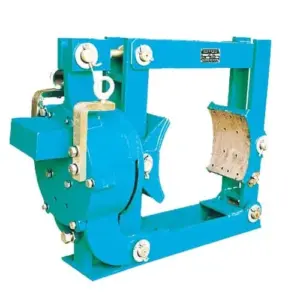
This article provides the engineering formulas and safety factors (K-factors) needed to size brakes correctly for hoists, travel drives, and belt conveyors. We will connect these calculations to our product lines, such as YWZ13 drum brakes for general crane duty and SH fail-safe disc brakes for high-energy holding.
Infographic showing the formula inputs: Motor Power (P), Speed (n), and Safety Factor (K).
1) The Fundamental Torque Formula
Start with the static torque required to hold the motor’s rated power. The governing equation is:
T_{static} = \frac{9550 \times P}{n}- $T_{static}$: Rated motor torque (N·m)
- $P$: Motor power (kW)
- $n$: Brake shaft speed (rpm) — Crucial: This is the speed at the brake, not the gearbox output!
- 9550: Constant converting kW/rpm to N·m.
Example: A 45 kW motor running at 750 rpm (common for crane hoists):
T_{static} = \frac{9550 \times 45}{750} = 573\ \text{N·m}Note: This is just to hold the motor against its own rating. It does not account for gravity, safety, or dynamic stopping.
2) Applying the Safety Factor ($K$)
You never select a brake at $T_{static}$. You apply a Service Factor ($K$) based on the risk and application type.
T_{brake} \ge T_{static} \times K| Application | Recommended $K$ Factor | Why? |
|---|---|---|
| Lifting (Hoisting) | $K \ge 2.0$ (Often 2.5 for molten metal) | Gravity is constant. If friction drops (fade/wear), you need 100% reserve capacity to prevent a drop. |
| Travel / Traverse | $K \approx 1.5 – 2.0$ | To stop within wind limits but avoid wheel skidding. Too much torque ($K>2.5$) causes wheel lockup and rail wear. |
| Belt Conveyors | $K \approx 1.5 – 2.0$ | Prevents rollback on inclined belts. Thermal capacity (stopping time) is often more critical than torque. |
| Winches (Man Riding) | $K \ge 3.0$ (Dual brakes often required) | Extreme safety requirement. |
Applying to our Example (Hoist):
Required Brake Torque = $573\ \text{N·m} \times 2.0 = 1146\ \text{N·m}$.
You would select a brake rated for at least 1200 N·m (e.g., a YWZ13-315 or YWZ13-400 model depending on thruster).
3) Thermal Capacity: The Hidden Killer
Calculated torque ensures you can hold the load. But can you stop it without burning the linings?
Stopping Energy Calculation
Every time you stop, kinetic energy turns into heat.
Energy ($E$) per stop (Joules):
- $J$: Total system inertia reflected to brake shaft (kg·m²).
- $\omega$: Angular velocity (rad/s) = $rpm \times \frac{2\pi}{60}$.
If $E$ exceeds the brake’s thermal rating (kJ per hour), the linings will glaze and fade.
Rule of Thumb: For high-inertia loads (conveyors, large fans), verify the thermal capacity of the disc/drum, not just the torque. You may need a ventilated disc (SH series) or a larger drum size just to dissipate heat.
4) Stopping Time Check
Will the machine stop fast enough?
Deceleration Time ($t$):
- $T_{brake}$: Actual torque setting.
- $T_{load}$: Load torque assisting (+) or resisting (-) the stop.
- Result: If $t$ is too long (> 3-5s for hoists), safety is compromised. If too short (< 0.5s for travel), shock loads will break components.
5) Selecting the Right Brake Series
Once you have the numbers, choose the hardware:
| Series | Type | Torque Range | Best For |
|---|---|---|---|
| YWZ13 / YWZ | Electro-Hydraulic Drum | 100 – 12,500 N·m | General Cranes: EOT bridges, gantries, general hoisting. Robust, easy maintenance. |
| SH / SB | Hydraulic Disc | 500 – 30,000+ N·m | Heavy Duty: High-speed stops, conveyors, container cranes. Better thermal dissipation. |
| SE / DC | Electromagnetic Disc | 5 – 500 N·m | Precision/Small: Machine tools, stage rigging, small hoists. Fast response. |
6) Common Selection Pitfalls
- Ignoring Gearbox Efficiency: If the brake is on the high-speed shaft, gearbox drag helps you stop. If on the low-speed shaft (safety brake), it doesn’t.
- Over-Torquing Travel Drives: Selecting $K=3.0$ for a crane bridge travel drive guarantees wheel skidding and swinging loads. Use $K=1.5$ or a variable-torque brake.
- Voltage Mismatch: Calculating torque perfectly but ordering the wrong thruster voltage (380V vs 415V vs 460V) means the project stalls at installation.
Need help sizing your brake?
Stop guessing. Send us your motor power (kW), speed (rpm), and application type (hoist/travel). Our engineering team will run the calculation, recommend the correct Safety Factor ($K$), and select the optimal brake model for your project.