
When a hydraulic brake “behaves strangely” on site—slow release, delayed apply, dragging, overheating, or inconsistent stopping—the brake itself is often blamed first. But on many systems, the real cause is the hydraulic piping layout: return line restrictions, unexpected back pressure, wrong throttling direction, or shared return manifolds that create pressure spikes.
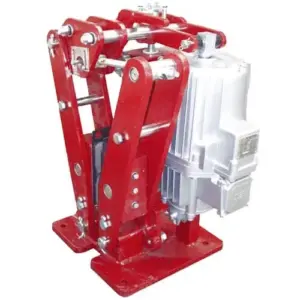
This is especially important for spring-applied, hydraulically released fail-safe brakes, where safe behavior depends on two things happening reliably: (1) the brake releases fully when pressure is applied, and (2) the brake applies fast when pressure is removed. In our product range, typical examples include SH Series Hydraulic Fail-Safe Disc Brakes (often supplied by a hydraulic power unit such as YZ / YZ(J) type hydraulic stations).
[Image Placeholder] Simple hydraulic schematic: HPU → directional valve → brake release port → brake cylinder → return line → tank (show optional flow control + check valve).
1) Two different “brake actions” need opposite hydraulic behavior
In fail-safe hydraulic brakes, the same hydraulic circuit must do two opposite jobs:
- Release (open the brake): deliver enough pressure and flow to overcome springs, move the piston, and achieve full air gap/clearance.
- Apply (close the brake): depressurize fast so springs can clamp quickly (this is your safety behavior during power loss/E-stop).
This is why piping details matter. A restriction that seems “small” (a narrow hose, a high-ΔP filter, a needle valve placed in the wrong direction) can slow depressurization and turn a fail-safe brake into a slow-safe brake.
2) Back pressure: the most underestimated reason fail-safe brakes apply slowly
Back pressure is pressure that remains on the brake release side when you want the brake to apply. It commonly comes from return-line restrictions, shared return manifolds, or throttling that blocks flow-out.
Even moderate back pressure creates a real counter-force on the release piston:
F = P \cdot AWhere P is back pressure and A is piston area. Example: if a brake’s release piston area is 25 cm² (0.0025 m²) and return back pressure is 2 bar (0.2 MPa), the counter-force is:
F = 0.2\times 10^6 \times 0.0025 \approx 500\ \text{N}That force may not “defeat” a large spring pack, but it absolutely affects how quickly pressure collapses and how fast the springs can move the mechanism—especially if the system also has trapped oil volume and restrictive flow paths.
Practical targets (starting point): many brake circuits aim to keep return-line back pressure low (often in the <0.5–2 bar range during discharge). The correct target depends on your required apply time and the brake’s spring force margin—but if you are seeing delayed brake apply, back pressure is one of the first measurements to take.
[Image Placeholder] Pressure trace: brake port pressure vs time during “apply.” Highlight how a restricted return creates a long tail instead of a sharp pressure drop.
3) Flow capacity sets timing: use volume/flow to sanity-check apply and release time
A brake release chamber has a finite oil volume. If you want fast apply, that volume must discharge quickly. A simple sanity check is:
t \approx \frac{V}{Q}
Where V is the effective oil volume that must move (L) and Q is flow rate (L/s). This is not a full dynamic model, but it quickly shows why small restrictions matter.
Example: if a brake release volume is 0.10 L and you want pressure to drop in about 0.3 s, the flow-out needs to be roughly:
Q \approx \frac{0.10}{0.3} \approx 0.33\ \text{L/s} \approx 20\ \text{L/min}
If your return path (hose + fittings + filter) effectively limits discharge to, say, 5 L/min, apply time can stretch beyond 1 second. In hoisting, wind, or emergency braking, that difference can be unacceptable.
4) Pipe diameter selection: velocity and pressure drop are your design controls
Even in “low-flow” brake circuits, undersized hoses cause pressure drop and back pressure during discharge. Two quick calculations help you size lines correctly.
A) Fluid velocity (helps pick a reasonable hose ID)
Velocity can be estimated from flow and diameter:
v=\frac{4Q}{\pi D^2}
Rule-of-thumb ranges (common practice):
- Pressure line: ~2–5 m/s
- Return line: ~1–2 m/s (lower is usually better for back pressure control)
Example: if discharge flow peaks around 10 L/min (0.000167 m³/s) and you choose a 10 mm ID hose (D=0.01 m):
v=\frac{4\times 0.000167}{\pi\times 0.01^2}\approx 2.1\ \text{m/s}
That’s already “pressure-line-like” velocity for a return path—often a hint that return diameter should be larger if you care about fast apply.
B) Pressure drop (why long small hoses create slow behavior)
A commonly used engineering estimate (Darcy–Weisbach) is:
\Delta P \approx f\frac{L}{D}\cdot \frac{\rho v^2}{2}
With typical hydraulic oil density ρ≈850 kg/m³ and friction factor f≈0.03 (order-of-magnitude), you can see scaling: pressure drop grows with L, and grows sharply as D gets smaller (because velocity increases).
Worked comparison (same flow, 15 m line):
- 10 mm ID: v≈2.1 m/s → ΔP on the order of ~0.8 bar
- 6 mm ID: velocity increases ~ (10/6)² ≈ 2.78× → pressure drop increases dramatically (often multiple bar range)
Multiple bar of return back pressure is exactly what slows apply and creates “delayed fail-safe.”
5) Throttling: control release speed without sacrificing fail-safe apply speed
Many systems need controlled release to avoid shock (especially in cranes and winches), but still need fast apply for safety. The usual design solution is:
- Throttle in one direction only (flow control valve + check valve)
- Free flow in the opposite direction to ensure fast apply/depressurization
Common pattern for hydraulic fail-safe brakes:
- Meter-in (release control): restrict flow into the brake release port to control how smoothly the brake opens.
- Free return (apply safety): allow oil to flow out freely (via check valve bypass) so pressure drops quickly when de-energized.
What often goes wrong is the throttle is installed so it restricts the discharge path (meter-out without bypass). That makes the brake apply slowly—exactly the opposite of what you want in a fail-safe system.
[Image Placeholder] Correct vs incorrect flow control orientation: (A) restrict on release, free on apply; (B) restrict on apply (unsafe).
6) Return line design: avoid shared return spikes and “hidden” restrictions
Brake return lines are frequently tied into a shared return manifold. That can work, but only if the shared line cannot generate back pressure spikes.
Common return-line problems we see in the field:
- Shared return with other actuators: another cylinder retracting can raise tank line pressure exactly when your brake needs to apply.
- Return filter too restrictive: high ΔP filters can create back pressure (especially when dirty).
- Undersized fittings: the “smallest ID wins.” One small elbow or quick-coupler can dominate pressure drop.
- Long flexible hoses: large line compliance can delay pressure collapse and create “soft” apply timing.
Practical design moves:
- Use a dedicated low-restriction return for the brake if apply time is safety-critical.
- If you must share, size the manifold for peak combined flow and keep brake return close to tank.
- Choose return filtration that stays low ΔP at expected flow; treat dirty filters as a timing hazard.
- Keep return routing short, avoid unnecessary quick couplers, and minimize sharp elbows.
7) Commissioning measurements that quickly reveal piping issues
To diagnose piping-related instability, measure at the brake—not only at the hydraulic station. Two sensors are especially useful:
- Pressure at the brake release port (fast pressure transducer if possible)
- Apply/release time (stopwatch + limit switch signal if available)
Recommended commissioning record items:
- release pressure at brake port (bar/MPa)
- time to full release (s) and achieved clearance (mm)
- time to full apply after valve de-energize (s)
- return line pressure during apply (if you can measure it)
- oil temperature (cold vs hot behavior)
If apply time gets worse as the system warms up, suspect return restrictions, oil degradation, or shared return spikes—not “weak springs.”
8) Product note: how this applies to SH hydraulic fail-safe brakes and hydraulic stations
Our SH Series Hydraulic Fail-Safe Disc Brakes are spring-applied and hydraulically released. That means correct piping is part of correct brake performance:
- release line must deliver pressure and flow to fully open the brake (clearance verified)
- return line must allow fast depressurization to achieve true fail-safe apply behavior
- throttling (if needed) should be arranged so it controls opening, not closing
When SH brakes are supplied by a hydraulic station (e.g., YZ / YZ(J) type), we recommend validating apply/release timing with the full piping installed—because a “good HPU” can still deliver poor results through a restrictive or incorrectly throttled line.
[Internal Link Placeholder] YZ / YZ(J) Hydraulic Power Unit (product page)
Need help reviewing your brake hydraulic schematic?
If you share your brake model (e.g., SH), line lengths and hose IDs, expected release volume, target apply/release times, and whether the return is shared, we can help you identify likely back-pressure risks and suggest a practical fix (diameter change, directional valve choice, throttle-with-check arrangement, or dedicated return routing).
[Internal Link Placeholder] Contact our engineering team for hydraulic brake circuit review.