
Industrial Drum Brakes for Smooth Deceleration and Fail-Safe Holding
Project Overview
A port logistics operator upgraded the braking system of its heavy-duty crane mechanisms to improve operational safety, braking smoothness, and long-term reliability. The application involved frequent start–stop cycles, high inertial loads, and strict requirements for holding and emergency braking.
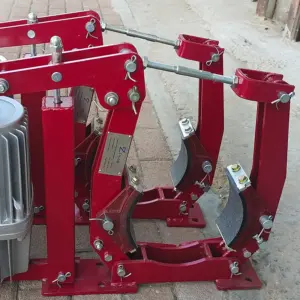
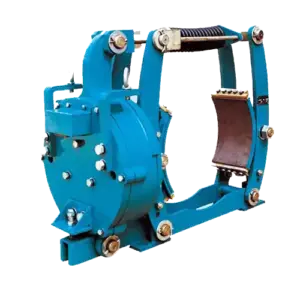
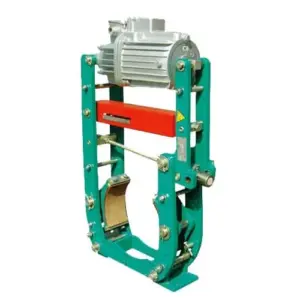
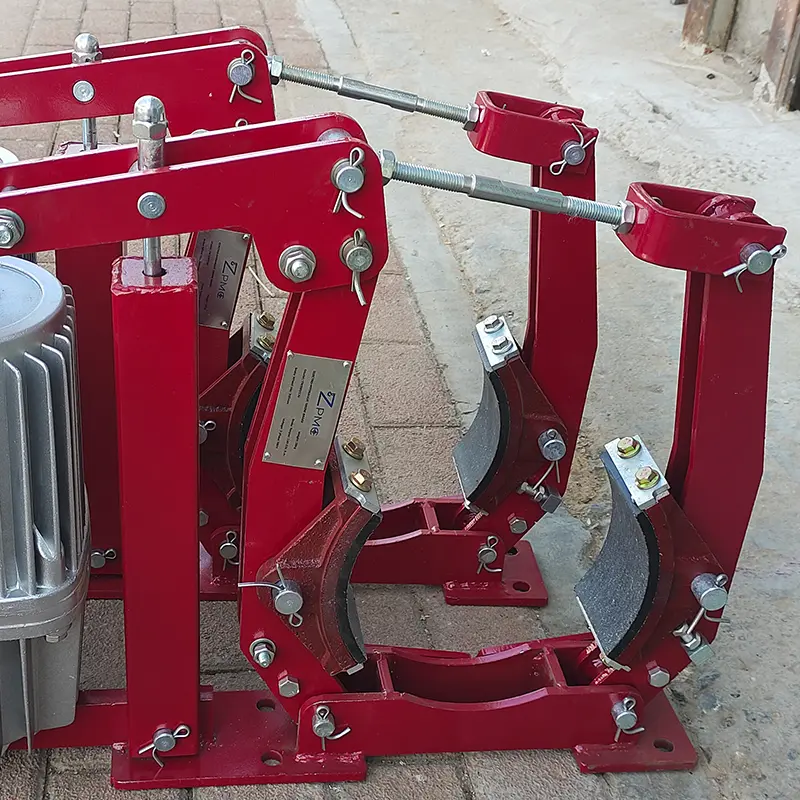
Industrial drum brakes were selected as the core solution due to their robust mechanical structure, high braking torque capacity, ease of maintenance, and cost-effective lifecycle performance. The final system combined electro-hydraulic drum brakes for service braking with electromagnetic drum brakes for safety and holding functions.
Application Challenges
Port crane operations place unique demands on braking systems:
- High-frequency operation: Repeated braking events increase thermal load and mechanical wear.
- Smooth deceleration: Abrupt braking can introduce shock loads that accelerate structural fatigue.
- Reliable holding: The brake must securely hold the load during positioning and when the crane is parked.
- Fail-safe behavior: In the event of power loss, the system must default to a safe braking state.
- Maintenance efficiency: Downtime and complex servicing must be minimized.
Solution Design
1. Service Braking: Electro-Hydraulic Drum Brakes
Electro-hydraulic drum brakes were used as the primary service braking solution. This brake type is widely applied in cranes, belt conveyors, and other transport machinery because it provides stable braking performance and fast release when combined with electro-hydraulic thrusters such as Ed or YT1 units.
Selection logic for this application included:
- General-purpose heavy-duty braking: YWZ4, YWZ8, and YWZ13 series for standard crane mechanisms.
- Consistent shoe clearance and balanced braking: YWZ3B, YWZ9, and YWZ10 series equipped with automatic shoe clearance equalization.
- Higher safety margin: YW-P series with additional spring-applied braking characteristics.
- Two-stage braking requirements: YW-E series, providing smooth deceleration during normal stops and enhanced braking force for emergency stops.
- Installation constraints: YW_L long-stroke designs for applications requiring extended actuator travel.
- Cost-effective baseline: YW series as a standardized and economical solution.
This configuration ensured smooth and controllable braking behavior under frequent duty cycles while maintaining fast response and release times.
2. Safety and Holding: Electromagnetic Drum Brakes
Electromagnetic drum brakes were introduced to handle holding and safety-critical functions. These brakes offer rapid response, precise control, and flexible safety logic, including fail-safe configurations.
Key configurations applied:
- MW(Z) electromagnetic drum brakes: Spring-applied and electromagnetically released, providing fail-safe holding in power-off conditions.
- DC electromagnetic options (ZWZ3 and ZWZA): Selected for applications requiring smooth, quiet, and stable braking characteristics.
- JZ energy-saving electromagnetic drum brakes: Used where reduced power consumption and lower operating costs were priorities.
By adding a dedicated fail-safe holding layer, the system achieved higher overall safety and redundancy.
3. Alternative Actuation Options
To accommodate different site conditions and retrofit scenarios, additional drum brake actuation methods were considered:
- Pneumatic drum brakes: Suitable for sites with reliable compressed air supply.
- Hydraulic drum brakes (TYW series): Used where exceptionally high braking forces are required and a hydraulic power unit is available.
- Foot-operated hydraulic drum brakes (TYWZ2): Applied as an emergency or backup braking solution in environments without electrical power.
Implementation Strategy
The upgrade followed a functional, system-level approach rather than focusing solely on individual brake models:
- Separation of service braking and holding/safety braking functions.
- Selection of brake type based on duty cycle, safety requirements, and available power sources.
- Use of standardized drum brake families to simplify maintenance and spare parts management.
- Alignment with the inherent advantages of drum brakes, including durability and ease of inspection.
Results and Operational Benefits
After commissioning, the port crane operator achieved the following outcomes:
- Smoother and more controlled deceleration, reducing mechanical shock and improving operating stability.
- Reliable holding performance, including fail-safe behavior during power loss or emergency conditions.
- Improved maintainability, supported by standardized and widely used drum brake designs.
- Optimized lifecycle costs, particularly where energy-saving electromagnetic brakes were implemented.
Conclusion
This project demonstrates how industrial drum brakes, when correctly selected and integrated, provide an effective solution for heavy-duty crane applications. By combining electro-hydraulic service brakes with fail-safe electromagnetic holding brakes, the system achieved a balanced result: smooth operation, high safety margins, and long-term reliability.
Industrial drum brakes remain a proven and adaptable braking technology for port cranes, conveyors, and other heavy industrial machinery where dependable stopping and holding are critical.