
When an industrial brake loses performance, most people look at lining material first. But in many heavy-duty applications (cranes, conveyors, metallurgy), the bigger risk is more basic: how the friction lining is attached. A high-quality lining can still fail early if the attachment method is mismatched to temperature, shock loading, contamination, or maintenance practices.
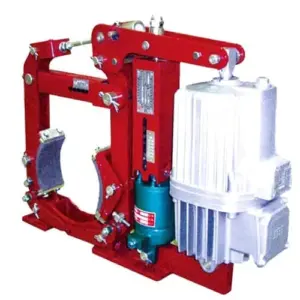
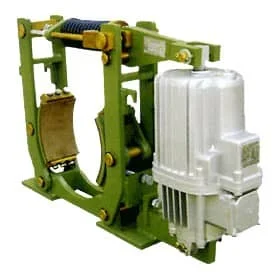
This article compares three common attachment methods—riveted, bonded, and bolted—with practical data ranges, typical failure modes, and selection guidance. Examples are aligned with our brake systems used across industry, such as YWZ13 electro-hydraulic drum (block) brakes (shoe linings) and SH hydraulic fail-safe disc brakes (pad assemblies on discs).
[Image Placeholder] Three samples side-by-side: riveted shoe lining, bonded shoe lining, bolted/segmented pad assembly.
Why attachment method changes braking behavior (not just “whether it stays on”)
The lining attachment must transfer tangential braking force into the shoe or backing plate without loosening, peeling, or cracking—over thousands of thermal cycles. One simple way to see the load path is to convert torque into tangential force at the effective radius:
F_t \approx \frac{T}{R_{eff}}That tangential force is what your rivets, adhesive layer, or bolts ultimately have to carry (with safety margin). If attachment capacity degrades with heat or contamination, you may see symptoms that look like “friction problems”: torque drift, chatter, hot spots, uneven wear, or sudden loss of braking.
Quick numeric example (useful for thinking, not a final design calculation): If a brake must deliver 10,000 N·m at an effective radius of 0.25 m, then:
F_t \approx \frac{10{,}000}{0.25}=40{,}000\ \text{N}That is 40 kN of tangential force trying to shear or peel the lining attachment during every stop. Any weakness in bonding, rivet setting, or bolt locking will show up fast—especially in high-duty crane travel and downhill conveyor braking.
Three attachment methods in industrial brakes (what each one really trades off)
| Method | Typical where used | Main strengths | Main risks | Maintenance notes |
|---|---|---|---|---|
| Riveted | Drum/block brake shoes (cranes, conveyors) | Strong mechanical retention; tolerant of heat spikes; less sensitive to oil than bonding | Rivet head exposure can score brake wheel; local stress around rivets; slightly reduced effective lining area | Monitor lining thickness above rivets; replace before rivets contact wheel |
| Bonded | Disc brake pads; many shoe linings; quieter applications | Full-area contact; smooth engagement; lower noise; often better wear utilization | Adhesive degradation at high temperature; edge lifting/peeling; sensitive to surface prep and curing | Inspect edges for separation; avoid overheating/dragging |
| Bolted / segmented | Heavy-duty calipers, large discs, some special shoes | Fast replacement; high security when designed correctly; good for large segments | Bolt loosening under vibration/thermal cycling; incorrect torque; corrosion seizure | Use correct torque + locking method; re-check after hot run |
In practice, you’ll also see hybrid designs (bonded + riveted) used when both high temperature and stable contact are required. The “best” method depends on duty cycle, environment, and how disciplined maintenance is on the site.
Riveted linings: when mechanical retention is the safer choice
Riveted linings are common on industrial drum/block brakes because they are mechanically secured even when temperatures spike. In crane travel brakes and many conveyor brakes—typical applications for YWZ13 series—this tolerance to harsh duty is a practical advantage.
Typical field advantages:
- Less sensitive to “one bad overheating event” compared with some bonding systems.
- Reliable in dusty environments where micro-abrasion is unavoidable.
- Provides a clear visual wear limit: when rivet heads get close, you must replace.
Common failure modes (what to look for):
- Rivet head exposure → scoring of brake wheel / braking surface damage.
- Cracking around rivet holes due to stress concentration, especially under shock loading.
- Loose rivets if rivet setting quality is poor or the shoe deforms.
Practical acceptance checks (fast and measurable):
- Minimum lining thickness above rivet heads (set a site rule; many teams use a conservative margin so rivets never touch the wheel).
- Rivet seating: no “rocking” lining segments, no visible gaps under the lining.
- Brake wheel surface inspection: any scoring should trigger earlier lining replacement and a drag investigation.
[Image Placeholder] Photo: rivet head near-surface condition vs rivet head contact damage on brake wheel.
Bonded linings: quiet, stable contact—until surface prep or heat is wrong
Bonded linings are extremely common in industrial disc brake pads and many shoe linings because they offer full-area support and smoother engagement. For caliper brakes, you typically have two interfaces:
- Friction material ↔ backing plate (usually bonded)
- Pad assembly ↔ caliper (retained by pins/bolts/clips)
For systems like our SH hydraulic fail-safe disc brakes, bonded pad integrity matters because these brakes are often used for holding and emergency duty—where pad detachment is not acceptable.
Practical data points (industry typical ranges):
- Many industrial bonding systems target adhesive shear strengths in the 10–25 MPa range (depends heavily on chemistry, temperature, and cure).
- Adhesive performance typically drops as interface temperature rises; repeated exposure to high peaks accelerates degradation.
Common failure modes:
- Edge lifting / peeling: often starts at corners where heat and shear concentrate.
- Bond-line heat damage: pads look “fine” until a high-temperature event causes sudden separation.
- Contaminated bonding surfaces: oil film, rust, or poor blasting reduces bond strength dramatically.
Two shop-floor controls that matter more than “brand adhesive”:
- Surface preparation (cleaning + roughening + correct primer if required)
- Curing control (temperature/time/pressure) and traceable batch records
[Image Placeholder] Cross-section sketch: correct bond line thickness vs voids/poor wet-out areas.
Bolted or segmented linings: serviceability wins—if you control torque and locking
Bolted/segmented linings are used when you want fast replacement and high mechanical security on large pad segments. In heavy-duty environments, this can reduce downtime significantly—especially when brake access is difficult. But bolted designs are only reliable if fasteners are treated as part of the braking system, not as “hardware.”
What usually goes wrong on site:
- Incorrect bolt torque (under-torque → loosening; over-torque → bolt yield or backing plate distortion)
- No locking method (no prevailing torque nut, no locking washer, no threadlocker, no safety wire—depends on design)
- Thermal cycling + vibration not accounted for (first hot run loosens bolts)
- Corrosion seizure on outdoor/port equipment (bolts cannot be serviced when needed)
If you use bolted pads, treat “torque + re-torque after first hot run” as a standard commissioning step.
[Image Placeholder] Photo: bolt locking methods commonly used on brake pad assemblies (locking plate, safety wire, prevailing nut).
Selection guidance by application (what typically works in the field)
Below are practical tendencies (not absolute rules). Final selection should follow your brake design, lining grade, and duty profile.
| Application | Most common attachment preference | Why |
|---|---|---|
| Crane travel / trolley brakes (high stop frequency) | Riveted or bonded (depending on temperature) | Needs repeatability; riveted tolerates abuse, bonded gives smooth contact if heat is controlled |
| Hoist holding / fail-safe holding | Bonded pads (OEM engineered) + secure pad retention | Uniform contact and predictable holding; must resist peel and creep at hot condition |
| Metallurgy / high temperature dust | Riveted or hybrid (bonded+riveted) | Heat spikes and contamination are common; mechanical backup reduces detachment risk |
| Outdoor / port corrosion exposure | Riveted or well-protected bolted systems | Bolts require corrosion strategy; rivets avoid seized fastener service problems |
Inspection cues: how to spot attachment problems early (before a stop becomes unsafe)
- Bonded pads/linings: check edges for lifting, cracks, “shadow gaps,” or heat-darkened bond lines.
- Riveted linings: check rivet head proximity to surface and any loose/rattling segments.
- Bolted pads: witness-mark bolts; re-check after the first hot run; inspect for backing plate distortion.
- Any type: if you see localized disc/wheel hot bands or rapid uneven wear, investigate alignment and dragging first.
[Internal Link Placeholder] Spare parts page for brake linings/pads (OEM matched sets)
Why OEM spare parts matter here (attachment is part of the safety design)
Changing attachment method without engineering validation is a common hidden risk. For example, switching a shoe from riveted to bonded (or using a different bonding process) can change heat transfer, peel resistance, and failure mode—especially in high-duty brakes such as YWZ-series crane brakes. Similarly, disc brake pads may “fit” the caliper but fail because the friction-to-backing plate bond system is not rated for the same temperature peaks and shear loads.
For safety-critical equipment, treat the lining attachment method as a specified component feature, not a manufacturing convenience. Using OEM-matched pads/linings keeps friction behavior and attachment integrity aligned with the brake’s design intent.
[Internal Link Placeholder] YWZ13 / YWZ brake spare parts kits (linings + pins/bushings + hardware)
[Internal Link Placeholder] SH series brake pad sets and replacement procedure