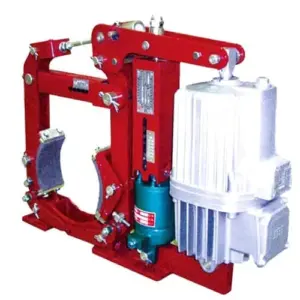

An industrial brake is a safety-critical mechanical device that slows, stops, or holds rotating equipment by converting kinetic energy into heat (dynamic braking) or by generating holding torque to prevent motion (static holding). Most industrial brakes create friction between a rotating element (disc or drum/brake wheel) and stationary friction surfaces (pads or shoes).
In many heavy-duty systems—especially cranes, hoists, conveyors, and wind turbines—the brake is designed as “spring-applied, power-released.” Springs apply the braking force by default, while hydraulic, pneumatic, electromagnetic, or electro-hydraulic power is used to release the brake during operation. This approach ensures that if power is lost, the brake automatically engages to secure the load and prevent runaway motion.
Key performance factors include rated torque, duty cycle, heat dissipation, friction material, and environmental resistance (dust, moisture, corrosion).