
Just like brake wheels on drum brakes, the brake disc (rotor) is a critical friction partner in disc brake systems. It’s not just a steel plate. The material grade, heat treatment, and surface finish determine whether your brake pads last 6 months or 6 weeks, and whether the disc warps or cracks under thermal load.
This article explains the material requirements for industrial brake discs used with our SH hydraulic fail-safe disc brakes and YPZ2 electro-hydraulic disc brakes, focusing on hardness, thermal stability, and wear resistance.
Cross-section of a ventilated brake disc vs solid disc, showing heat flow paths.
1) The Job of the Disc: More Than Just Friction
The disc must survive three brutal conditions simultaneously:
- Thermal Shock: Surface temperature can jump from 20°C to 300°C+ in seconds during an emergency stop.
- Mechanical Stress: Centrifugal force at high RPM tries to burst it; clamping force tries to crush/warp it.
- Wear & Tear: Pads grind against it constantly. It must be hard enough to resist grooving but tough enough not to crack.
2) Material Selection: Cast Iron vs. Steel
Most industrial brake discs are made of Cast Steel or Ductile Iron, unlike automotive discs which are often Gray Iron.
Cast Steel (e.g., ZG35CrMo, ZG42CrMo)
Common for: High-speed, high-energy brakes (wind turbines, large hoists).
- Pros: High strength, excellent toughness (won’t burst easily), good thermal conductivity.
- Cons: Can be harder to machine to a perfect finish; slightly lower damping than iron (more prone to squeal).
Ductile Iron (e.g., QT500-7, QT600-3)
Common for: General industrial brakes, lower speeds.
- Pros: Good wear resistance, better damping (quieter), easier to cast complex shapes (ventilated discs).
- Cons: Lower thermal shock resistance than alloy steel; risk of thermal cracking in extreme duty.
3) Hardness: The “Goldilocks” Zone
Disc hardness must match the brake pad material. If the disc is too soft, the pads eat it. If it’s too hard, the pads glaze or crack.
- Typical Range: 220–280 HB (Brinell).
- Too Soft (< 200 HB): Rapid disc wear, deep grooving, frequent replacement.
- Too Hard (> 300 HB): Pad glazing, noise, potential for surface micro-cracking (heat checking).
Heat Treatment: Discs are usually Quenched and Tempered (Q+T) to achieve uniform hardness and structure throughout the cross-section, not just on the surface.
4) Surface Finish: Ra Value Matters
The surface texture (roughness) determines how quickly new pads bed in and how stable the friction is.
- Target Ra: 1.6 – 3.2 µm.
- Too Smooth (< 0.8 µm): Pads glaze; low initial torque; long bedding-in time.
- Too Rough (> 6.3 µm): Rapid pad wear; noise; excessive heat generation.
Machining Direction: Ideally, the finish should be non-directional (cross-hatch) or circumferential, not radial grooves.
5) Ventilation: Solid vs. Ventilated Discs
Heat dissipation is the limiting factor for brake duty cycle.
- Solid Disc: Simple, robust, good thermal mass for single stops (emergency brakes). Slower to cool down.
- Ventilated Disc: Has internal vanes to pump air. Cools much faster. Essential for high-cycle applications (service brakes, tension control).
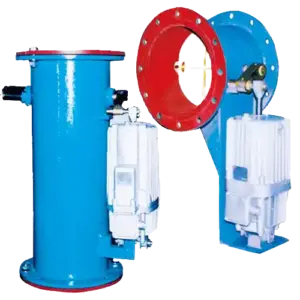
SH Series Hydraulic Fail-Safe Disc Brakes (Often paired with ventilated discs for high energy)
6) Maintenance: Checking Your Disc Health
Don’t wait for the disc to crack. Inspect it during every pad change:
- Thickness: Measure at 3–4 points. Replace if below minimum thickness (usually marked on the edge).
- Runout: Check with a dial indicator. > 0.1–0.2 mm runout causes pad knock-back and vibration.
- Cracks: Look for “heat checks” (small spiderweb cracks). Small ones are okay; cracks extending to the edge or through the thickness are immediate failure.
- Grooves: Deep ridges mean abrasive wear. Resurface or replace.
Need replacement brake discs?
We supply high-quality brake discs (solid and ventilated) matched to our caliper brakes. Specify diameter, thickness, hub bore, and material requirement (or application duty) for a quote.
Contact us for brake disc specifications and pricing.