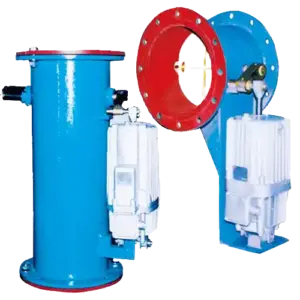

You can buy the best brake in the world, but if you install it crooked, it will fail like the cheapest one. Misalignment is the single most common cause of rapid lining wear, localized overheating, and vibration in industrial braking systems. It is also the reason why some brakes “never seem to release properly” despite having a perfectly good thruster.
This article details the three critical alignment dimensions—Center Height, Parallelism, and Symmetry—and how to set them correctly for YWZ13 electro-hydraulic drum brakes and SH hydraulic fail-safe disc brakes.
Diagram showing the three alignment errors: (A) Brake too low/high (Center Height), (B) Brake twisted relative to shaft (Parallelism), (C) Brake off-center left/right (Symmetry).
1) Why “Close Enough” isn’t Good Enough
Industrial brakes run with tight clearances (often 0.8–1.0 mm per side). If alignment is off by just 2 mm, one side drags continuously. This creates a “parasitic load” that generates heat, degrades the oil in the thruster, and glazes the friction material.
2) Dimension A: Center Height (Vertical Alignment)
The horizontal centerline of the brake must match the horizontal centerline of the brake wheel or disc shaft.
For Drum Brakes (YWZ Series)
The Error: If the brake is too low, the top edge of the shoe lining hits the wheel first. If too high, the bottom hits.
- Target: Coaxiality tolerance usually ≤ 1–2 mm (depending on size).
- Check: Measure the distance from the base plate to the brake pivot center. Compare it to the gearbox shaft height.
- Fix: Use full-area steel shims under the brake base. Do not use washers (they allow the base to flex).
For Disc Brakes (SH Series)
The Error: If the caliper is too low, the pad overhangs the outer edge of the disc (creating a “lip” on the pad that eventually touches each other). If too high, the pad rubs the disc hub.
- Target: Pad outer radius matches disc outer radius exactly (or typically 1–2 mm inside).
- Fix: Adjust shims under the caliper base or mounting bracket.
3) Dimension B: Parallelism (Angular Alignment)
The brake base must be parallel to the shaft axis. If the brake is “twisted,” the shoes/pads contact at an angle.
- Symptom: Tapered wear (wedge shape) on linings. One corner of the pad wears out while the rest is new.
- Check:
- Drum: Release the brake. Check the gap at the front and back edge of the shoe. They should be equal.
- Disc: Check the gap at the leading and trailing edge of the pad.
- Fix: This usually means the mounting foundation is uneven. You may need to shim one corner of the brake base or machine the mounting pedestal.
4) Dimension C: Symmetry (Left/Right Centering)
The brake wheel/disc must be centered exactly between the two arms/caliper halves.
The “Equal Gap” Rule
When the brake releases, the air gap (clearance) on the left should equal the gap on the right.
- If Asymmetric: One side opens wide (wasting stroke), while the other side barely opens (or drags).
- Adjustment Feature:
- YWZ13: Has a “Equal Retreat Distance” device (linkage) that mechanically forces both arms to open equally. You must adjust the limit bolt on this device during installation.
- SH Disc Brakes: Often use “floating” mounts or return springs that need balancing. Fixed calipers require precise shimming to center the disc.
YWZ13 Series (See “Equal Clearance Device” feature)
5) A Simple Alignment Procedure (The “Loose Bolt” Method)
For base-mounted drum brakes, a common field trick helps establish initial centering:
- Position the Brake: Place it over the wheel with mounting bolts loose.
- Apply the Brake (Manually): Allow the springs to clamp the shoes onto the wheel. The spring force will naturally “center” the brake body onto the wheel (if it can slide).
- Tighten Bolts Partially: Snug the bolts while the brake is holding the wheel.
- Release and Check: Release the brake electrically. Check if gaps are equal.
- Shim and Torque: Measure any vertical gap under the base (shimming required) before final torque. Never pull a gap closed with bolt tension—this distorts the brake frame and causes binding.
6) Shimming Best Practices
Shims are your primary alignment tool. Use them correctly:
- Material: Stainless steel or plated steel shims (resist rust/compression). Avoid plastic or soft aluminum.
- Shape: U-shape (slotted) shims are easiest for retrofits (slide in around bolts).
- Coverage: The shim pack should support the entire foot area of the brake base, not just the area around the bolt hole. Unsupported bases flex and crack.
7) Verification After 24 Hours
New installations often “settle.” After the first day of operation (or first thermal cycle):
- Re-check air gap symmetry. (Did the base shift?)
- Look for “rub marks” on the wheel/disc. (Is one side dragging?)
- Check witness marks on mounting bolts.
Need installation support?
We provide installation dimension drawings and adjustment manuals for all our brake models. If you are retrofitting a YWZ13 or SH brake into an existing spot and need help with mounting adapter plates or alignment tolerances, our engineering team can review your layout.