
In international brake projects, many mistakes are not engineering mistakes—they’re language mistakes. A buyer says “caliper brake,” but means a spring-applied fail-safe unit. A technician says “air gap,” but measures shoe clearance on a drum brake. A drawing says “thruster,” but procurement buys a hydraulic cylinder. These misunderstandings create wrong selection, wrong spares, and slow commissioning.
This article provides a practical industrial brake terminology glossary (English to Chinese) focused on the words that most often cause confusion in cranes, conveyors, wind/winch systems, and general heavy industry. Where product references are useful, we relate terms to our common brake series such as YWZ13 electro-hydraulic drum brakes, SH hydraulic fail-safe disc brakes, and SE electromagnetic fail-safe brakes.
[Image Placeholder] Diagram labeling key terms: caliper, disc, pads, air gap, brake-open switch, thruster, linkage, shoe, brake wheel.
How to use this glossary (so it helps in RFQs and commissioning)
For each term, we list:
- English term (common variations)
- Chinese term(s) used in industry
- Practical meaning (what you should verify)
- Common confusion (what it is often mistaken for)
If you frequently send RFQs, a good practice is to copy the exact term plus the parameter that defines it (e.g., “fail-safe brake, spring applied, hydraulic released, release pressure ___ bar”). That prevents “same word, different product.”
Core brake mechanism terms
| English | Chinese | Practical meaning | Common confusion |
|---|---|---|---|
| Brake | 制动器 | Complete braking device (actuator + friction elements + structure) | “Friction pad” only |
| Braking torque | 制动力矩 / 制动扭矩 | Torque capability under defined conditions (temperature, lining, clearance) | Thermal capacity (not the same) |
| Fail-safe brake | 失电制动器 / 常闭制动器 / 安全制动器 | Applies when power is removed (spring-applied, power-released) | Any brake that “seems safe” |
| Service brake | 工作制动器 | Used for routine deceleration during operation | Parking brake |
| Parking brake | 驻车制动器 / 停车制动器 | Used for holding at rest (often fail-safe) | Emergency brake |
| Emergency brake | 紧急制动器 | Used for abnormal events; higher energy per stop may apply | Normal service stop |
Disc brake terms (caliper, pads, rotor/disc)
| English | Chinese | Practical meaning | Common confusion |
|---|---|---|---|
| Caliper brake | 钳盘式制动器 / 盘式制动钳 | Brake clamps a disc with pads inside a caliper | “Any disc brake” (some designs are not calipers) |
| Disc / Rotor | 制动盘 | Rotating friction component; geometry (runout/finish) affects stability | Brake wheel (drum) |
| Brake pad | 制动片 / 摩擦片(盘式) | Friction material + backing plate; attachment method matters | Drum brake lining |
| Pad carrier | 制动片支架 / 片架 | Guides pad movement; sticking here often causes drag | Back plate |
| Air gap | 气隙 / 间隙 | Clearance between pad and disc when released | Shoe clearance on drum brakes |
| Pad knock-back | 回缩 / 回推 | Disc runout pushes pads back; increases effective air gap and delays torque | Weak hydraulic pressure |
Product context: our SH hydraulic fail-safe disc brakes are caliper-type disc brakes widely used for holding and emergency duty. When someone says “caliper,” confirm whether they mean fail-safe (spring-applied) or power-applied (less common for safety duty).
Drum/block brake terms (shoes, lining, brake wheel)
| English | Chinese | Practical meaning | Common confusion |
|---|---|---|---|
| Drum brake / Block brake | 鼓式制动器 / 块式制动器 | Shoes/blocks press on a rotating brake wheel (drum) | “Band brake” (different mechanism) |
| Brake shoe | 闸瓦 / 制动瓦 | Steel shoe with lining attached | Friction lining itself |
| Lining | 衬垫 / 摩擦衬垫 / 闸瓦衬垫 | Friction material on shoes; attachment method (riveted/bonded) matters | Disc brake pad |
| Brake wheel | 制动轮 / 制动鼓 | Rotating friction partner; hardness/finish affect wear and stability | Disc (rotor) |
| Shoe clearance | 闸瓦间隙 / 制动间隙 | Gap between lining and wheel when released (must be symmetric) | Air gap (disc brake term) |
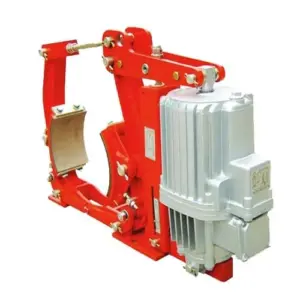
Product context: our YWZ13 electro-hydraulic drum brakes are typical “block brakes.” If an RFQ says “drum brake air gap,” confirm whether they mean shoe clearance and ask for measurement points.
Actuation terms (thruster, hydraulic station, coil, rectifier)
| English | Chinese | Practical meaning | Common confusion |
|---|---|---|---|
| Thruster (electro-hydraulic thruster) | 电力液压推动器 | Self-contained motor-pump-cylinder actuator used to release brakes | Hydraulic cylinder (requires external HPU) |
| Hydraulic power unit (HPU) | 液压站 | External hydraulic station supplying pressure to release/apply cylinders | Thruster |
| Release pressure | 松闸压力 / 释放压力 | Pressure needed to fully open a spring-applied brake | System relief pressure (not always same at brake port) |
| Solenoid valve | 电磁阀 | Controls hydraulic flow; orientation affects apply speed | Contactor/relay |
| Coil | 线圈 | Electromagnetic actuator winding; voltage and insulation class matter | Motor winding |
| Rectifier | 整流器 / 整流模块 | Converts AC to DC for brake coils; influences release time and heat | Transformer |
Practical clarification you can use in emails:
- “Thruster” = a complete electro-hydraulic actuator unit (motor + pump + cylinder) used on many drum brakes.
- “HPU/hydraulic station” = an external power pack for hydraulic brakes (common with fail-safe disc brakes).
Switches and monitoring terms (brake-open, wear switch, limit switch)
| English | Chinese | Practical meaning | Common confusion |
|---|---|---|---|
| Brake-open switch | 开闸限位 / 松闸开关 | Confirms brake is fully released before motion is allowed | “Motor running” signal |
| Brake-closed switch | 抱闸限位 / 制动到位开关 | Confirms brake applied/holding state | Wear switch |
| Wear switch | 磨损开关 / 片厚开关 | Warns that pad/lining has reached a wear limit | Brake-open switch |
| Limit switch | 限位开关 | Generic term; must specify function (open/closed/wear) | Interlock relay |
Commissioning warning: a wiring team may connect a “brake-open switch” backwards (NO/NC confusion). Always verify switch state by observing the brake mechanism position—not only PLC input status.
Performance and condition terms (dragging, fade, glazing, runout)
| English | Chinese | Practical meaning | Common confusion |
|---|---|---|---|
| Dragging | 拖闸 / 抱死不全 / 半抱闸 | Brake not fully released; creates heat continuously | Normal warm brake |
| Fade | 热衰退 / 制动衰退 | Torque decreases as temperature rises | Low torque due to wrong sizing |
| Glazing | 发亮 / 玻璃化 | Friction surface becomes smooth/shiny; torque becomes unstable | Normal wear polish |
| Runout (TIR) | 跳动 | Disc wobble during rotation; causes pad knock-back and hot bands | Flatness (different) |
| Hot spot / hot banding | 热点 / 热带 | Localized overheating on disc/wheel; often due to misalignment/runout/drag | Normal temperature rise |
Email/RFQ phrases that reduce misunderstanding (copy/paste)
These short lines make technical communication clearer:
- “We need a fail-safe brake (spring-applied, power-released) with rated torque ___ N·m at disc diameter ___ mm.”
- “Please confirm release method: electro-hydraulic thruster (Ed/YT1) or external HPU (YZ/YZJ).”
- “Please provide air gap (disc brake) or shoe clearance (drum brake) setting range and measurement points.”
- “Confirm accessories: brake-open switch, wear switch, manual release, IP rating.”
Need a terminology block for your product pages (SEO-friendly and buyer-friendly)?
If you tell me which product page you want to strengthen first (YWZ13, SH, SE, thrusters, discs), I can draft a compact “Terminology & Definitions” section tailored to that product. This improves search relevance for mixed-language queries like “caliper brake fail safe,” “thruster brake,” “brake lining vs pad,” and reduces RFQ errors.