견적 요청
메시지를 남겨 주세요. 12시간 이내에 답변 드리겠습니다.

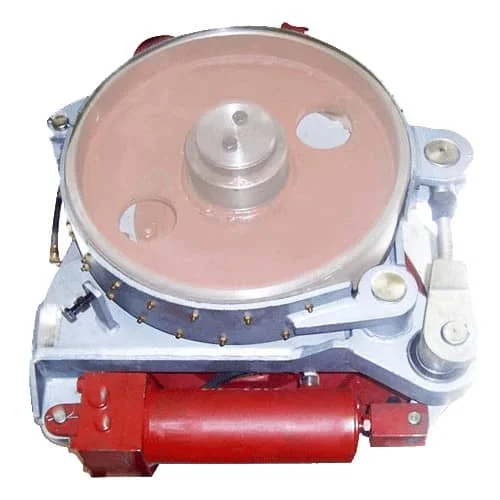
The band brake is a relatively simple yet highly effective braking mechanism. Its core principle involves a flexible steel band lined with friction material that wraps around and tightens onto a rotating brake drum (or wheel), using friction to halt or slow its rotation.
회전하는 플라이휠 주위에 벨트를 조여 벨트를 단단히 조일수록 플라이휠의 회전 속도가 느려져 결국 멈춥니다.
핵심 구성 요소 및 작동 원리:
제동 드럼: Mounted on the rotating shaft requiring braking, it rotates with the shaft.
Brake Band: A flexible steel band with wear-resistant friction linings (similar to brake pads) attached to its inner surface.
액추에이터: A device such as a lever, hydraulic cylinder, or pneumatic cylinder that tightens or loosens both ends of the brake band.
When braking is required, the actuator tightens the brake band, causing it to wrap tightly around the brake drum. Significant friction develops between the friction lining and the drum surface, converting rotational kinetic energy into heat energy to achieve deceleration or locking.
Distinctive Features and Professional Assessment:
Advantage 1: Self-Energizing Effect: This is the most significant advantage of band brakes. As the brake drum rotates, it tends to “wind” the brake band tighter, amplifying the applied braking force. This allows substantial braking torque to be generated with minimal operating force. It is why band brakes are used for static holding or emergency braking in many heavy-duty applications.
Advantage 2: Simple Construction, Low Cost: Compared to complex disc or drum brakes, it has fewer components and is relatively straightforward to manufacture and maintain.
Disadvantage 1: Directional Sensitivity: The self-energizing effect is typically pronounced only in one direction of rotation. Braking effectiveness is significantly reduced during reverse rotation. This makes it unsuitable for applications requiring equal braking performance in both directions.
Disadvantage 2: Poor heat dissipation: The large surface area of the brake band wrapped around the drum restricts airflow, hindering heat dissipation during braking. Consequently, it is unsuitable for applications requiring frequent, high-energy dynamic braking, as heat fade can lead to brake failure.
Disadvantage 3: Uneven Wear: Pressure distribution across the brake band is not entirely uniform, potentially causing uneven wear on the friction linings.
벨 제동은 "보편적이거나 고성능" 솔루션이 아닙니다. 강한 자가에너지 효과와 단순한 구조를 활용하여 정적 주차 브레이크(Parking Brake)나 비상 안전 브레이크(Emergency Brake)로 급유장치, 크레인, 윈치, 컨베이어 벨트와 같은 기계에서 없어서는 안 될 역할을 합니다. 그러나 정확한 제어, 양방향 제동, 효율적인 열 분산이 필요한 다이나믹한 응용—예를 들어 서보 모터와 엘리베이터—에는 디스크 브레이크가 여전히 최상위 선택입니다.