OBTER ORÇAMENTO
Por favor, deixe-nos uma mensagem, e responderemos dentro de 12 horas.

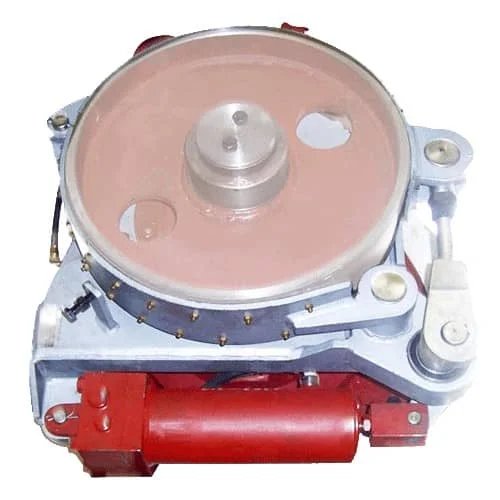
The band brake is a relatively simple yet highly effective braking mechanism. Its core principle involves a flexible steel band lined with friction material that wraps around and tightens onto a rotating brake drum (or wheel), using friction to halt or slow its rotation.
Você pode visualizar isso como apertar uma cinta em torno de um volante giratório—quanto mais apertada a cinta, mais devagar o volante gira até eventualmente parar.
Componentes Centrais e Princípio de Funcionamento:
Tambor de Travão: Mounted on the rotating shaft requiring braking, it rotates with the shaft.
Brake Band: A flexible steel band with wear-resistant friction linings (similar to brake pads) attached to its inner surface.
Atuador: A device such as a lever, hydraulic cylinder, or pneumatic cylinder that tightens or loosens both ends of the brake band.
When braking is required, the actuator tightens the brake band, causing it to wrap tightly around the brake drum. Significant friction develops between the friction lining and the drum surface, converting rotational kinetic energy into heat energy to achieve deceleration or locking.
Distinctive Features and Professional Assessment:
Advantage 1: Self-Energizing Effect: This is the most significant advantage of band brakes. As the brake drum rotates, it tends to “wind” the brake band tighter, amplifying the applied braking force. This allows substantial braking torque to be generated with minimal operating force. It is why band brakes are used for static holding or emergency braking in many heavy-duty applications.
Advantage 2: Simple Construction, Low Cost: Compared to complex disc or drum brakes, it has fewer components and is relatively straightforward to manufacture and maintain.
Disadvantage 1: Directional Sensitivity: The self-energizing effect is typically pronounced only in one direction of rotation. Braking effectiveness is significantly reduced during reverse rotation. This makes it unsuitable for applications requiring equal braking performance in both directions.
Disadvantage 2: Poor heat dissipation: The large surface area of the brake band wrapped around the drum restricts airflow, hindering heat dissipation during braking. Consequently, it is unsuitable for applications requiring frequent, high-energy dynamic braking, as heat fade can lead to brake failure.
Disadvantage 3: Uneven Wear: Pressure distribution across the brake band is not entirely uniform, potentially causing uneven wear on the friction linings.
Os freios de cinta não são uma solução “universal” ou “de alto desempenho”. Aproveitando seu forte efeito de autoenergização e estrutura simples, eles servem como freios estacionários estáticos indispensáveis (Freio de Estacionamento) ou freios de segurança de emergência (Freio de Emergência) em equipamentos como guinchos, gruas, guinchos e correias transportadoras. No entanto, para aplicações dinâmicas que exigem controle preciso, frenagem bidirecional e dissipação eficiente de calor—como motores servo e elevadores—os freios a disco continuam sendo a escolha superior.