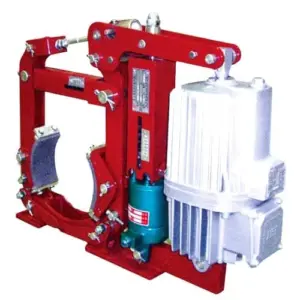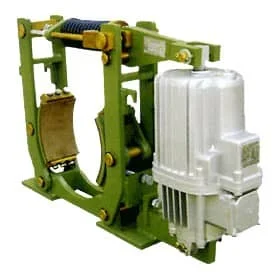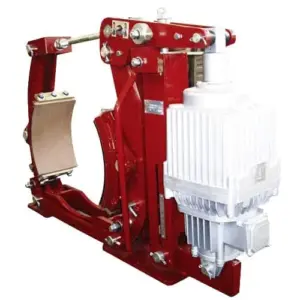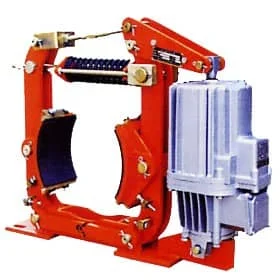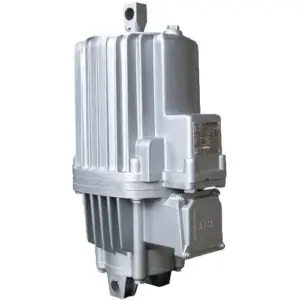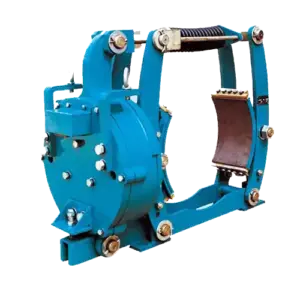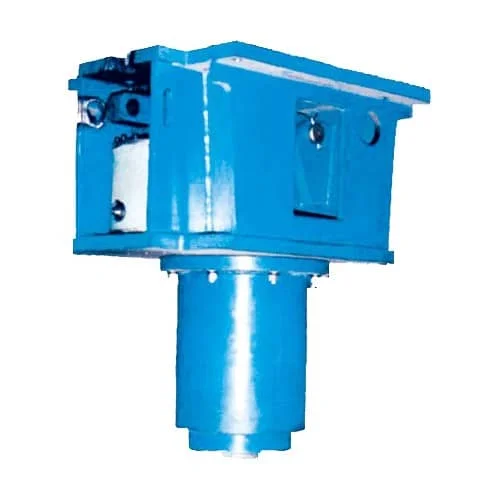
The YDGZ-40 hydraulic rail clamp is the definitive storm brake solution for protecting multi-million dollar port cranes and rail-mounted equipment against destructive high-wind events. Delivering a formidable 400 KN (40.8 metric tons) of clamping force, the YDGZ-40 employs a proven spring-applied, hydraulic-release design that ensures your equipment remains securely anchored even during complete power failures—the most critical moment in any storm emergency.
Weighing 1110 kg of heavy-duty industrial construction, the YDGZ-40 is engineered to withstand the extreme vibration, shock loads, and corrosive marine atmospheres that destroy lesser rail brakes. Precision-machined friction blocks and a robust lever mechanism translate hydraulic pressure into an unyielding grip on crane rails, preventing the catastrophic runaway that high winds can inflict on unsecured equipment.
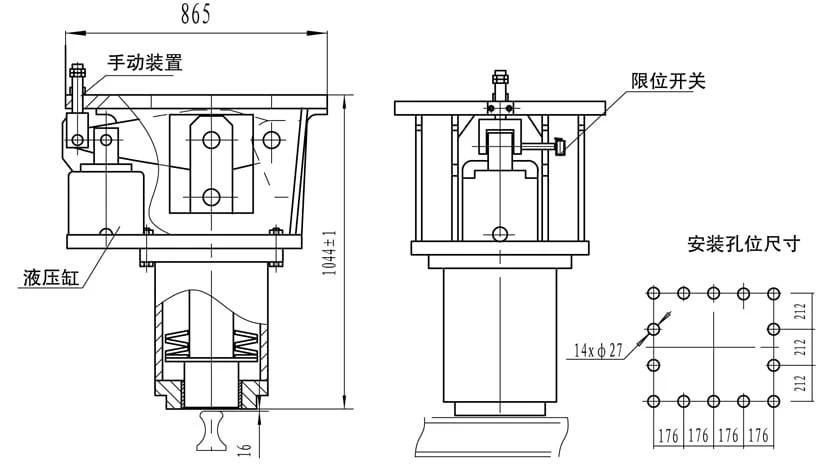
Key Specifications at a Glance
| Parameter | Specification |
|---|---|
| Rated Clamping Force | 400 KN (40.8 metric tons) |
| Working Hydraulic Pressure | 8 MPa |
| Plunger Stroke | 16 mm |
| Weight | 1110 kg |
| Operating Temperature | 0°C to +40°C |
| Relative Humidity | ≤ 90% |
| Control | Spring-applied, hydraulic release |
| Manual Override | Included (manual release handle) |
| Position Feedback | Onboard limit switches (clamped/released) |
Why Choose YDGZ-40 Rail Clamp?
1. Massive 400 KN Clamping Force
The YDGZ-40 delivers 400 KN of vertical clamping force directly onto the rail web through an efficient lever mechanism. This immense friction lock prevents crane movement in wind speeds that would shift lesser brakes. The clamping force translates to:
- Resistance to wind loads exceeding 150 km/h on standard gantry cranes
- Secure parking of fully loaded ship-to-shore cranes
- Emergency braking capability integrated with crane control systems
2. Inherently Fail-Safe Spring-Applied Design
Safety in storm conditions depends on brakes that work when power fails—exactly when you need them most. The YDGZ-40 uses a spring-applied, hydraulic-release design:
- Braking Force: Pre-loaded disc springs apply clamping force continuously
- Release: Standard 8 MPa hydraulic pressure overcomes spring force to release
- Fail-Safe: Any loss of hydraulic pressure immediately engages the full clamping force
This means the YDGZ-40 is always in the clamped position by default. Whether the power grid fails, a hydraulic hose ruptures, or an emergency stop is triggered, the rail clamp responds by tightening its grip—never by releasing.
3. Heavy-Duty Industrial Construction
Weighing 1110 kg, the YDGZ-40 is built for decades of reliable service in the harshest environments:
- Rugged body engineered to withstand extreme vibration and shock loads
- Corrosion-resistant construction for marine and port atmospheres
- Precision-machined friction blocks from advanced high-wear-resistant steel
- Long service life with minimal maintenance requirements
4. Manual Release for Installation & Emergency
The YDGZ-40 includes an integrated manual release handle that allows disengagement without hydraulic power. This critical feature provides:
- Installation flexibility: Position the clamp during crane assembly without hydraulics
- Commissioning convenience: Test operation before connecting hydraulic lines
- Emergency override: Manual release when hydraulic system is damaged
5. PLC-Compatible Position Feedback
Integrated limit switches provide unambiguous “clamped” and “released” status signals to your crane’s PLC control system. This integration:
- Prevents accidental crane drive activation while the rail clamp is engaged
- Confirms safe parking state for operator verification
- Enables automated wind storm protocols that set brakes before power shutdown
How YDGZ-40 Rail Clamps Work
Storm Protection Mode (Clamped)
In the clamped (parked) position, the YDGZ-40 operates as a mechanical lock:
- Disc springs push the clamping mechanism downward onto the rail web
- The lever mechanism multiplies spring force into 400 KN of vertical clamping force
- Friction blocks grip the rail, preventing any horizontal movement
- Wind forces trying to push the crane are resisted by the friction grip
Operational Mode (Released)
When the crane needs to move, hydraulic pressure is applied:
- 8 MPa hydraulic pressure enters the clamp cylinder
- Hydraulic force overcomes the spring preload
- The clamping mechanism lifts slightly, releasing the grip on the rail
- Crane can now travel freely along the rail
Wind Load Calculation
The YDGZ-40’s 400 KN clamping force creates a friction lock that resists wind loading. The resisting moment is calculated as:
Friction Force = μ × Clamping Force
Where μ (friction coefficient) is typically 0.3-0.4 for steel-on-steel contact. With 400 KN clamping force and μ = 0.35:
Resisting Force = 0.35 × 400 KN = 140 KN
This 140 KN resisting force can prevent crane movement in wind speeds exceeding 150 km/h for typical gantry crane configurations. For specific wind load calculations for your crane, consult our engineering team.
Primary Applications
The YDGZ-40 is the storm brake of choice for securing large, valuable rail-mounted equipment against high winds and emergency situations.
Port & Terminal Cranes
The primary application for YDGZ-40 rail clamps is ship-to-shore (STS) cranes and rubber-tyred gantry (RTG) cranes in ports worldwide. These multi-story machines represent investments of $5-15 million each, and a single runaway crane incident can cause catastrophic damage to ships, infrastructure, and surrounding equipment. The YDGZ-40 provides:
- Typhoon and hurricane protection for coastal ports
- Secure parking during ship loading/unloading interruptions
- Emergency stop capability integrated with vessel approach detection
Shipyard Cranes & Goliaths
Massive shipyard gantry cranes (also called Goliath cranes) used in ship construction and repair face extreme wind exposure in coastal yards. The YDGZ-40 provides the heavy clamping force needed to secure these enormous structures during construction pauses and severe weather events.
Industrial Gantry & Overhead Cranes
Large gantry cranes and bridge cranes in steel mills, power plants, and manufacturing facilities use YDGZ-40 rail clamps for:
- Storm protection in outdoor or open-bay configurations
- Emergency parking during equipment failures
- Secure positioning during maintenance operations
Stacker-Reclaimers & Bulk Handling
Stacker-reclaimer machines in coal yards, ore stockpiles, and bulk terminal operations use YDGZ-40 rail clamps to prevent wind-induced movement that could damage conveyor systems, trestles, or the machines themselves.
YDGZ-40 vs YJGQ: Choosing the Right Rail Clamp
| Feature | YDGZ-40 | YJGQ Series |
|---|---|---|
| Clamping Force | 400 KN (fixed) | 160 – 600 KN (variable models) |
| Design | Lever-type, top-of-rail | Multiple designs (top-of-rail, web) |
| Hydraulic Requirement | 8 MPa | 10-16 MPa (varies by model) |
| Weight | 1110 kg | 180 – 500 kg (varies) |
| Manual Release | Included | Included |
| Position Switches | Included | Included |
| Best For | Large STS cranes, heavy gantries | Versatile, multiple crane sizes |
Choose YDGZ-40 when: You need maximum clamping force (400 KN) for the largest port cranes, ship-to-shore cranes, and heavy Goliath cranes where storm protection is critical.
Choose YJGQ series when: You need a versatile rail clamp available in multiple force ratings (160-600 KN) for different crane sizes, or when lower hydraulic pressure requirements simplify your system design.
Storm Brake System Configuration
The YDGZ-40 is typically part of a comprehensive storm protection system for port cranes. A complete setup usually includes:
Recommended Configuration for Ship-to-Shore Cranes
- 2× YDGZ-40 rail clamps – One on each rail at the waterside (storm-facing) end
- 2× YLBZ wheel brakes – Hydraulic wheel-side brakes on all drive wheels
- 1× YFX wedge brake (optional) – Additional wheel arrestment on non-drive wheels
- Storm detection sensor – Wind speed monitor triggering automatic engagement
Control Integration
The YDGZ-40 integrates with crane control systems through its limit switch outputs:
- CLAMPED signal: PLC confirms safe parking before operator leaves crane
- RELEASED signal: Drive enable for crane travel
- Wind storm protocol: Automated engagement when wind speed exceeds threshold
Installation Requirements
Environmental Conditions
- Operating Temperature: 0°C to +40°C (standard); extended range available
- Relative Humidity: ≤ 90% (non-condensing)
- Environment: Marine, port, outdoor industrial; anti-corrosion options available
Hydraulic System Requirements
- Working Pressure: 8 MPa
- Hydraulic Fluid: HM hydraulic oil (or equivalent)
- Pilot Ratio: Designed for standard crane hydraulic systems
- Hose Connection: Standard hydraulic fittings (size to be specified)
Rail Compatibility
The YDGZ-40 is designed for standard crane rails including:
- CR73, CR89, CR105 rails (and equivalent)
- UIC 54, UIC 60 rails
- Custom rail profiles available on request
Frequently Asked Questions
What is the difference between a rail clamp and a wheel brake for storm protection?
Rail clamps (like YDGZ-40) grip the rail directly, preventing any crane movement. Wheel brakes (like YLBZ) apply braking to the wheel tread. For complete storm protection, both are typically used together: rail clamps provide the primary anchor, while wheel brakes provide additional wheel arrestment and can function as service brakes during normal operation.
How many YDGZ-40 rail clamps do I need for my gantry crane?
Most standards require one rail clamp per rail, positioned at the storm-facing end of the crane. For ship-to-shore cranes, this typically means two YDGZ-40 clamps (one on each rail) at the waterside end. Some operators add additional clamps at the landside end for extra security during severe typhoons.
What happens if hydraulic pressure is lost during a storm?
This is exactly when the YDGZ-40 design provides maximum safety. The spring-applied design means that ANY loss of hydraulic pressure—including hose rupture, pump failure, or power loss—causes the clamp to automatically ENGAGE, not release. The crane becomes MORE secure, not less, as the springs take over. This fail-safe behavior is why spring-applied rail clamps are required by crane safety standards worldwide.
Can the YDGZ-40 be retrofitted to older cranes?
Yes, in most cases. The YDGZ-40 can be mounted to existing rail clip brackets or base plates with minor modifications. Our engineering team can provide retrofit guidance including mounting adapter designs, hydraulic piping layouts, and electrical integration. Many older STS cranes have been successfully upgraded with YDGZ-40 rail clamps.
What maintenance does the YDGZ-40 require?
The YDGZ-40 is designed for minimal maintenance: (1) Monthly visual inspection for leaks, wear, and secure mounting; (2) Quarterly verification of limit switch operation; (3) Annual inspection of friction blocks for wear (replace when worn to minimum thickness); (4) Periodic hydraulic system maintenance per crane manufacturer recommendations. The manual release mechanism should be tested quarterly to ensure free operation.
Related Products & Storm Protection System
Complete your crane storm protection system with these complementary products:
- YLBZ Series Hydraulic Wheel Side Brake – Wheel tread braking for drive wheel arrestment, used with rail clamps for complete storm protection
- YJGQ Hydraulic Rail Clamp – Alternative rail clamp available in 160-600 KN force ratings for various crane sizes
- YFX Electric Hydraulic Windproof Iron Wedge Brake – Wedge-type wheel brake for additional non-drive wheel arrestment
- YWZ13 Series Electric Hydraulic Drum Brake – Hoist and travel drum brakes for ship-to-shore crane applications
Request a Quote for YDGZ-40 Rail Clamps
Protect your port equipment investment with proven YDGZ-40 storm brake technology. Our engineering team specializes in storm protection systems for port cranes and can help you design the optimal configuration for your specific crane model and local wind conditions.
Contact us today to discuss your storm protection requirements, request dimensional drawings, or receive a detailed quotation for YDGZ-40 rail clamps and complete brake systems.